
When a surveyor or an OCR investigator asks who is responsible for HIPAA security at your facility, whose name comes to mind? At a lot of nursing homes the honest answer is the IT provider, the administrator, or nobody in particular. That answer misses a federal requirement that has been on the books since 2005, and it usually fails in documents that were never written rather than in a dramatic citation.
The HIPAA Security Officer is the named person accountable for a continuing security program, not a title handed to whoever manages the network. This walkthrough goes step by step through what the Security Rule requires, which record proves each duty, and which decisions stay with your staff no matter how much technical work an outside provider handles. For anything that turns on your own policies or contracts, confirm the detail with your compliance officer or counsel.
Table of Contents
- Core Duties of the HIPAA Security Officer
- Why Covered Entities Must Name a Security Officer
- How to Run the HIPAA Risk Analysis Cycle
- Access Control and Workforce Safeguards to Enforce
- Splitting Work Between Security, Privacy and IT Teams
- Keeping Care Running During Downtime and Recovery
- Applying the Role in a Skilled Nursing Facility
- Confirm Your Security Officer Plan This Quarter
Core Duties of the HIPAA Security Officer
The HIPAA Security Officer is the person your organization names as accountable for protecting electronic protected health information (ePHI) and for proving that protection with documents. HHS uses the term security official, and the job is described as developing and implementing the policies and procedures that keep ePHI safe. Everything else follows from that sentence. Someone has to own the program, not just the servers.
The table below is the working version of that duty list. Each row names the standard in 45 CFR Part 164, the duty it creates, and the record a surveyor, an investigator or your own counsel should be able to see on request.
| Duty | Security Rule reference | Record the officer produces |
|---|---|---|
| Assign and document security responsibility | 45 CFR 164.308(a)(2) | Written designation with defined scope |
| Conduct an accurate and thorough risk analysis | 45 CFR 164.308(a)(1)(ii)(A) | Risk analysis report covering all ePHI systems |
| Manage identified risks | 45 CFR 164.308(a)(1)(ii)(B) | Risk management plan with owners and due dates |
| Control workforce access and termination | 45 CFR 164.308(a)(3) and (a)(4) | Access approval and removal procedures and records |
| Run security awareness and training | 45 CFR 164.308(a)(5) | Training schedule and attendance records |
| Lead security incident procedures | 45 CFR 164.308(a)(6) | Incident response plan and incident logs |
| Maintain the contingency plan | 45 CFR 164.308(a)(7) | Data backup, disaster recovery and emergency mode operation plans |
| Review system activity and audit controls | 45 CFR 164.308(a)(1)(ii)(D) and 164.312(b) | Activity review records and audit logs |
| Evaluate security periodically | 45 CFR 164.308(a)(8) | Evaluation reports after significant changes |
| Retain security documentation | 45 CFR 164.316 | Policies and procedures kept for six years |
Look at the right-hand column. Almost none of it is equipment. A firewall shows up in the risk analysis and the access records; the officer's deliverable is the evidence that someone chose, checked and corrected it.
Working rule: if a row has no current record behind it, that gap is the first thing to fix this quarter. A missing record is the practical definition of a missing control.
Treat the table as a checklist rather than a reading exercise. Pull the ten records, put them in one folder, and note which ones are dated within the last year. Then confirm the mapping against your own policies with your compliance officer or counsel, because a table that doesn't match how your facility operates is worse than no table at all.
Why Covered Entities Must Name a Security Officer
Ask who owns security at a facility that outsources its IT, and the answer often comes back as a shrug toward the vendor. The Security Rule does not accept that answer. Under 45 CFR 164.308(a)(2), every covered entity must assign responsibility for security management to a named individual, which is why the designation shows up in every audit protocol and enforcement action. HHS published the HIPAA Security Standards Final Rule on February 20, 2003, establishing national standards for ePHI, and most covered entities had to comply by April 20, 2005, according to the HHS Security Rule guidance. Enforcement authority moved to the HHS Office for Civil Rights (OCR) on July 27, 2009.
Who has to comply: health plans, healthcare clearinghouses, providers that bill electronically, and business associates that create, receive or maintain ePHI on their behalf. A skilled nursing facility submitting Medicare and Medicaid claims electronically generally falls inside that group, and so does the billing vendor that handles the files. The designation itself cannot be delegated. A managed IT provider can run the monitoring, patching and firewall work under a business associate agreement, but the officer's name on the designation belongs to the covered entity.
The enforcement record is the argument for treating the designation as continuing work rather than a line on an org chart. From the start of OCR's Security Rule enforcement reporting in October 2009 through November 30, 2013, HHS received approximately 768 complaints alleging Security Rule violations, according to OCR's enforcement highlights.
Each complaint pulls an organization into a process measured in months or years. Policies get reviewed, training records get requested, remediation gets checked line by line. The practical lesson for a busy administrator is that evidence has to exist before anyone asks for it.
A security program that only produces paperwork during an investigation has already lost the argument. The documents should be a byproduct of work you did months earlier.
Software helps with the record-keeping, though it doesn't decide anything. A 2025 HIPAA Journal survey found that 57% of respondents were using software for HIPAA compliance tracking and management, based on a survey conducted in the fourth quarter of 2024, per the HIPAA Journal annual survey. Some facilities widen the search and compare risk software for hospitals alongside dedicated HIPAA trackers, since a shared register of findings and owners is easier to audit than a folder of spreadsheets.
The rule sets no certification requirement and no minimum credential, so the choice of who serves is yours. The designation works like a fire marshal's role in a building: a contractor can inspect the extinguishers, but the marshal still signs the plan and answers for it. An outside IT provider can carry out the technical work, yet the duty to direct it, document it and correct what it finds stays with the officer. What the rule does demand is real authority to act, budget to fix what the analysis finds, and a line to the executive who can approve both. Write the designation down, date it, and give it scope.
How to Run the HIPAA Risk Analysis Cycle
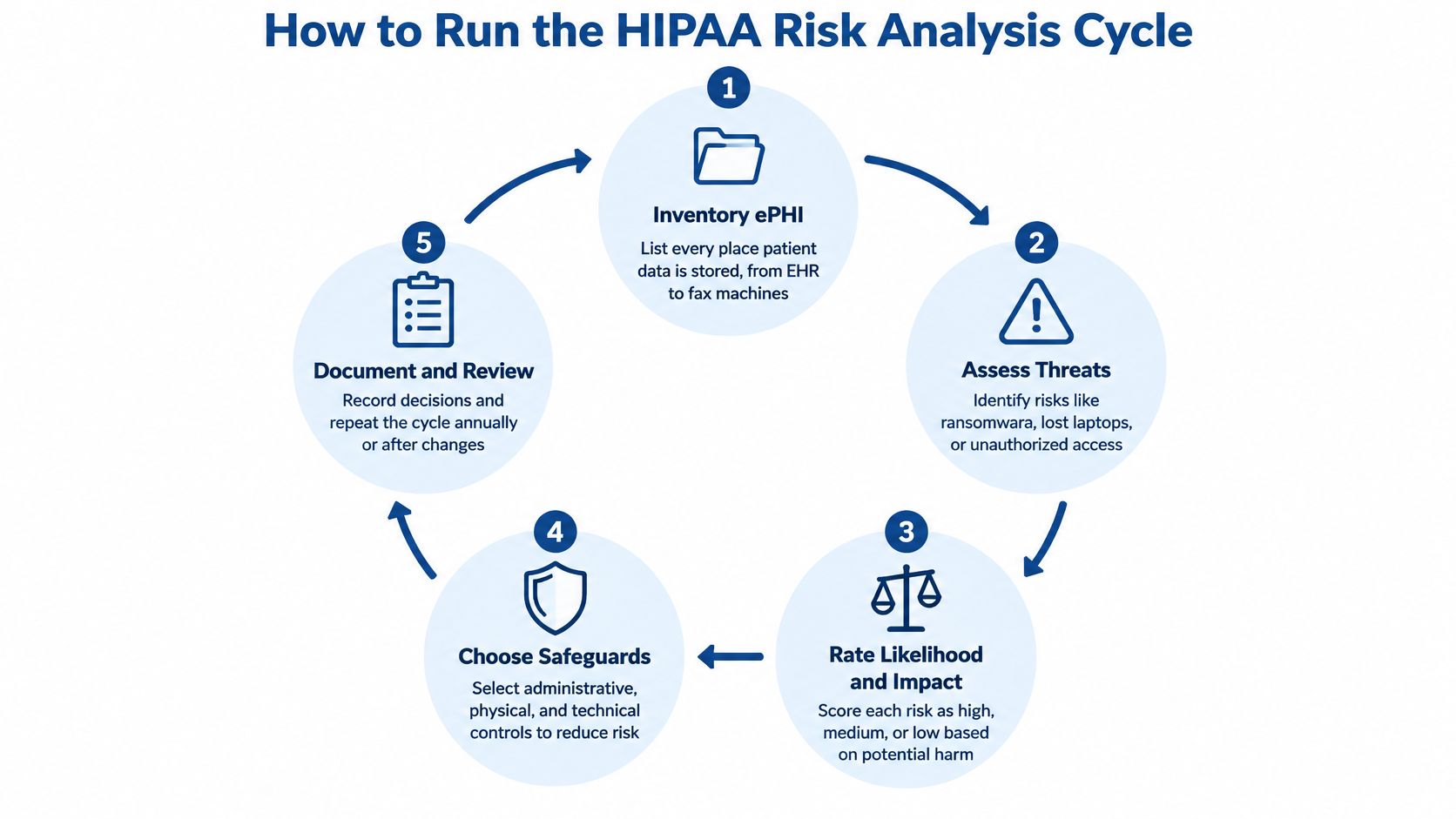
A risk analysis is a working cycle, not a form to complete once and file away. It helps the Security Officer decide which safeguards the organization needs by identifying where electronic protected health information (ePHI) is held and how it could be exposed, altered, or made unavailable. The officer remains accountable for keeping the process current, even when an outside IT provider gathers technical details or carries out fixes.
The analysis runs through the steps below, in order.
- Scope the analysis. List the ePHI environment, including the electronic medical record, medication platform, file shares, backups, cloud services, endpoints, interfaces, and third-party connections. Starting with the server room alone can leave out a fax-to-email gateway, pharmacy interface, or therapy documentation system.
- Gather data on systems, users, access paths, and vendors. Map who reaches what, and through which route. Check that the asset list reflects current systems and connections.
- Identify threats and vulnerabilities. Consider shared logins, unpatched systems, unmanaged remote-support tools, and stale accounts. Include risks from both outside attackers and workforce activity.
- Assess existing safeguards. Record which controls reduce each risk and whether they are operating. A purchased control does not reduce risk if it is not configured or used.
- Determine likelihood. Assess how probable exploitation or error is given the safeguards in place. Ratings should help distinguish risks, not leave every item at the same level.
- Determine impact on confidentiality, integrity, and availability. Consider what could happen if ePHI were exposed, altered, or unavailable, including the effect of downtime on care.
- Determine overall risk. Combine likelihood and impact into a rating that helps the organization rank findings and decide where to direct resources.
- Select, document, and track security measures. Assign each action to an owner, set a due date, and record the remaining risk after the planned measure is applied.
Keep the findings in a risk register that connects each risk to its owner, due date, residual risk rating, and evidence that the relevant control is operating. Reassess when a new system, staffing change, building, or vendor changes the ePHI environment. HIPAA does not prescribe one technology stack; safeguards must be reasonable and appropriate for the organization's size, complexity, and capabilities.
An IT provider can help inventory systems, monitor networks, manage patches, or implement other technical measures. The Security Officer still owns the analysis: confirming its scope, deciding whether findings are addressed, assigning responsibility, and tracking unresolved risk. For an overview of the related policies and procedures, see HIPAA administrative safeguards.
Access Control and Workforce Safeguards to Enforce
Start with the everyday version of the question. A nurse manager pulls a chart on a shared nursing station computer. Who is allowed to be logged in, and can anyone tell afterwards which person opened that record? The HIPAA access-control standard requires technical policies and procedures that allow only authorized people or software programs to reach ePHI.
HHS's technical safeguards guidance lists four implementation specifications for access control.
- Unique user identification (required). Every nurse, aide, therapist, contractor and vendor gets their own account. No shared logins on station computers, ever.
- Emergency access procedures (required). A documented route to needed information during an outage or an urgent clinical situation, one that still records who viewed what.
- Automatic logoff (addressable). Sessions end after inactivity, which matters most on shared workstations in hallways and medication rooms.
- Encryption and decryption (addressable). Data is protected at rest and in transit, so a stolen laptop isn't a reportable event by default.
Addressable does not mean optional. The organization has to assess whether the specification is reasonable and appropriate, implement it when it is, or document why an equivalent alternative is in place. An undocumented "we decided against it" is the finding, not the control.
For a facility running an EHR such as PointClickCare, unique accounts do two jobs at once. They attribute chart activity to a person, and they make revocation possible on the day someone leaves. Practical steps look like this:
- Joiners. Approve role-based access before the first shift, signed off by the department lead, not by whoever happens to be at the desk.
- Movers. Adjust permissions the week a CNA becomes a medication aide, and remove the old role rather than layering a new one on top.
- Leavers. Disable the account on the last day, collect the badge and any device, and record who did it.
Multi-factor authentication has become a common way to make credential theft harder, and Microsoft 365 MFA security covers how that looks in a Microsoft environment. Whatever mix you choose, the officer keeps the evidence: access approval forms, a current user list by role, termination tickets and periodic access reviews.
For the technical side in more depth, HIPAA technical safeguards walks through audit logging, integrity controls and transmission security.
Splitting Work Between Security, Privacy and IT Teams
Picture a certified nursing assistant who emails a resident's chart to a personal account so she can finish notes at home. Three different questions land on three different desks within the hour. Who contains the account and preserves the logs, who decides whether this is a reportable breach, and who writes down what was decided and why?
That scenario is where most confusion about the HIPAA Security Officer role shows up. The Security Officer and the Privacy Officer are separate designations with different scopes, and an outside IT provider executes controls without ever carrying accountability for them.
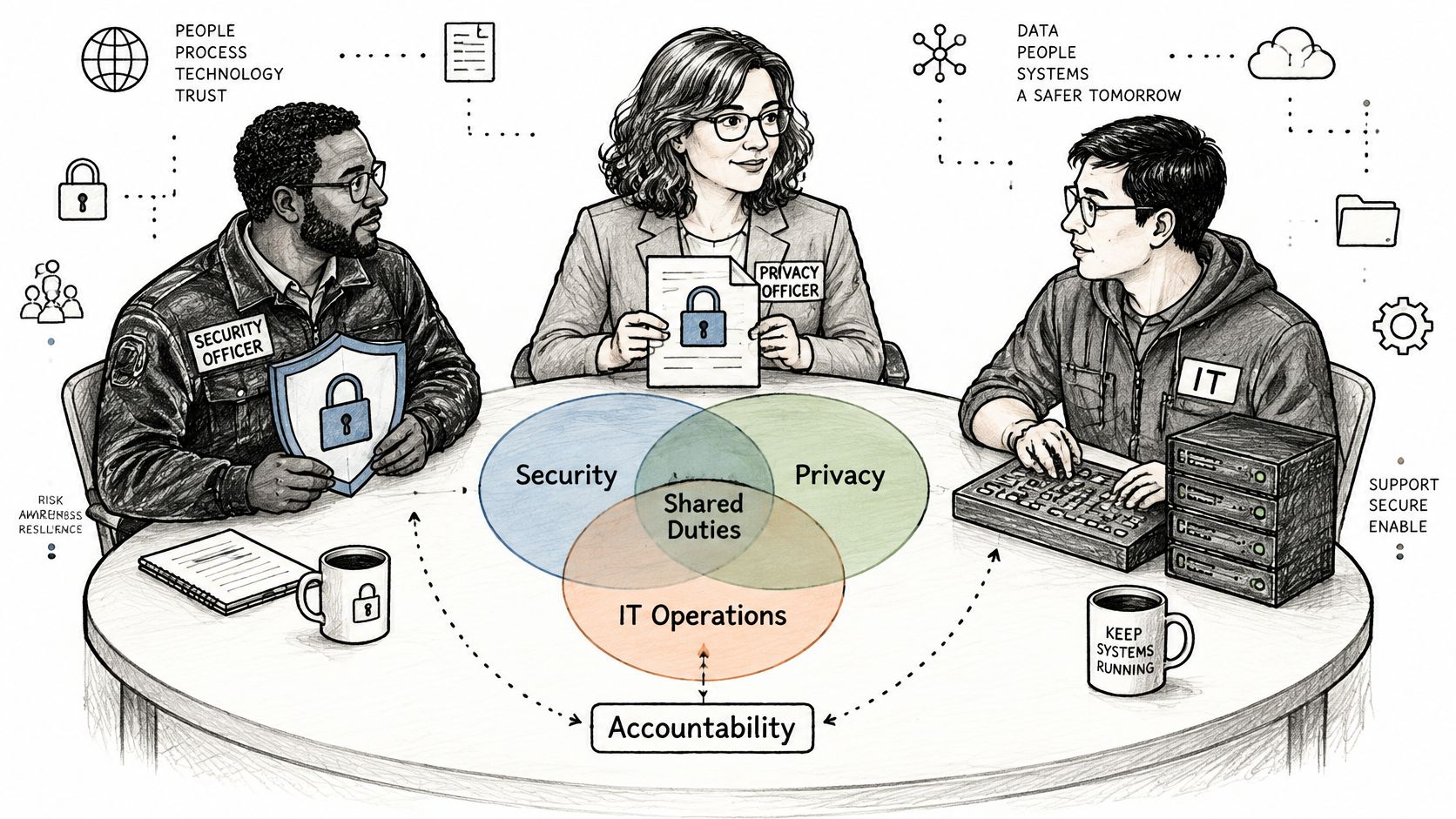
The table shows how the same five tasks split across the three parties.
| Task | HIPAA Security Officer | Privacy Officer | IT team or outside provider |
|---|---|---|---|
| Risk analysis | Leads and documents | Consulted on uses of PHI | Supplies system and access data |
| Access rules | Sets security policy and approves the model | Reviews minimum necessary use | Configures and reviews accounts |
| Workforce training | Owns security awareness content | Owns privacy training content | Delivers and tracks technical training |
| Security incident response | Leads technical response and records | Assesses breach notification duties | Contains systems and preserves logs |
| Business associate agreements | Reviews security terms | Reviews privacy and contract terms | Confirms vendor controls are in place |
Business associate contracts are required under 45 CFR 164.308(b), and the split in the last row is the one that causes trouble. The officer reviews whether the vendor's safeguards are adequate for the ePHI involved. The privacy officer or counsel reads the permitted uses, the reporting obligations and the termination language.
Here's the same scenario, handled cleanly. The Security Officer directs the technical response, opens an incident record and tracks remediation to closure. The Privacy Officer works through the breach notification analysis. The IT team disables the account, checks what was sent and preserves the mailbox logs. Nobody waits for someone else to start.
Keep one written decision log across all three roles, so every owner can point to the decisions that were theirs and the date they made them.
An organization can assign both officer roles to one person, provided the responsibilities for each program are documented and the person has the time and expertise to carry both. What doesn't work is leaving the split informal, because the gap only becomes visible during an incident.
The video below walks through how the pieces fit together day to day.
Keeping Care Running During Downtime and Recovery
In long-term care, availability is a clinical issue. Medication administration, clinical records, nurse call, communications, admissions and billing all depend on the same network, and a ransomware event or a vendor outage can take them down together. The contingency plan standard at 45 CFR 164.308(a)(7) has four parts: a data backup plan, a disaster recovery plan, an emergency mode operation plan, and testing and revision procedures.
HHS has proposed, but not finalized, a rule that would require written procedures to restore certain relevant systems and data within 72 hours, set restoration priorities by the criticality of systems and assets, and maintain tested incident-response procedures, as summarized in the HHS fact sheet on the proposed Security Rule. Confirm the current status with counsel before you build commitments around it.
The trend line explains the urgency. HHS-OIG reports that affected patient records rose from 6 million in 2010 to 170 million in 2024, while hacking or IT-related incidents grew from 2% of breaches to 91%, and across 2010 to 2024, 88% of 732 million affected records were attributed to hacking or IT issues, per the same HHS fact sheet.
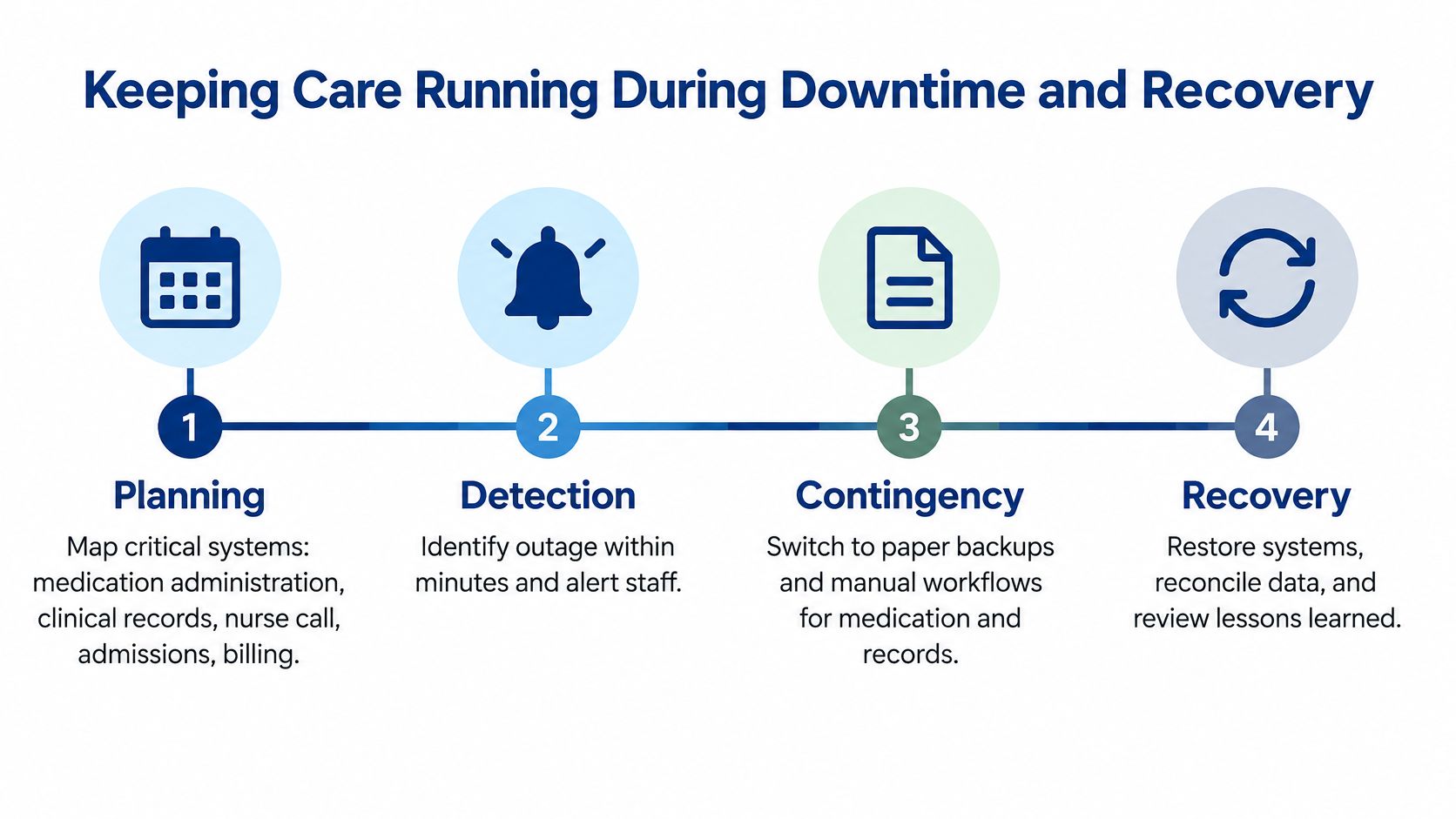
Set a restoration order and write it into the plan.
- Clinical records and medication systems. Without the MAR and the chart, the shift can't run safely.
- Nurse call and communications. Residents need a way to reach staff, and staff need to reach each other.
- Admissions and billing. Important, but they can wait a day.
- Administrative systems. Email, scheduling and back office come last.
Each phase needs a downtime workflow attached: paper MARs and progress notes, offline medication references, printed call lists for on-call managers and pharmacy, and a named person who can authorize emergency chart access during the outage. Record every exercise with the corrective actions it produced.
For planning the response side, this cyber incident response plan guide from By Design Law Firm sets out the sequence counsel expects to see documented.
Immutable backups are not a recovery strategy. Restores still have to be tested, priorities still have to be set, and someone still has to reconcile the paper record with the system when it comes back.
For a worked version of that switchover, EHR downtime procedures for nursing homes lays out the paper forms and reconciliation steps.
Applying the Role in a Skilled Nursing Facility
It's 2 a.m. on a Tuesday. The night shift is documenting in an EHR such as PointClickCare from nursing station desktops and medication carts, the nurse call system is live, residents are on the facility Wi-Fi, and the VoIP phones carry the on-call line. Then the EHR stops responding for every building on the account.
The first question isn't technical. It's who authorizes paper documentation and emergency chart access, and can the charge nurse reach the person who can make that call at 2 a.m. If the answer depends on the administrator's cell phone being on, the plan has a single point of failure.
Nurse call, resident Wi-Fi and the phones belong in the asset inventory when they sit near or touch ePHI systems, and the officer decides how they're segmented from clinical systems. That's a design decision with a compliance consequence, so it belongs in the risk analysis rather than in a vendor's change ticket.
The contingency plan should also line up with the CMS emergency preparedness requirements at 42 CFR 483.73, so the document your team rehearses is the same one a surveyor will ask about. Confirm the current survey expectations with your compliance officer, since interpretive guidance shifts.
What multi-building operators should decide
For an operator running several facilities, one risk analysis covers every building, findings are reported by facility, and a single policy set applies everywhere. A hospital-based unit, a memory care wing and a rural satellite don't get separate rulebooks; they get separate findings under the same policies.
An outside provider can monitor, patch, back up and maintain firewalls, and a help desk staffed around the clock with reporting by building gives the officer visibility between quarterly reviews. What the provider can't do is accept risk on the organization's behalf.
The officer keeps the decisions: the designation, policy approval, workforce access sign-off, and the risk acceptance recorded when something is fixed later rather than now. Those entries belong in the same decision log used for incidents, so the facility can show a consistent record of who decided what.
Confirm Your Security Officer Plan This Quarter
A quarterly review works when it produces evidence, not reassurance. The officer should be able to point to a named owner, a current risk analysis, clean access lists, a rehearsed recovery path and vendor paperwork that matches reality.
Five checks will tell an administrator whether the program holds up.
- Designation. The Security Officer is named in a written, dated document that has been shared with the executive team.
- Scope. The risk analysis covers every building and every ePHI system, including nurse call, resident Wi-Fi and vendor interfaces.
- Access. Current user lists are reviewed, and shared or orphaned accounts are closed.
- Recovery. The contingency plan lists restoration priorities and a downtime exercise is on the calendar.
- Vendors. Business associate agreements are on file for every vendor with ePHI access, and each has been reviewed against current requirements.
If a check fails, record the decision that follows. A gap fixed next month is different from a gap accepted without review; the decision log should show which one happened and who signed it.
RDE Technologies provides IT security management services that support the technical side of this work, including server and network monitoring, network security, firewalls, content filtering, managed antivirus for desktops and servers, patch management for desktops, and advanced ransomware protection for endpoints. That support can carry monitoring, patching and recovery tasks, while designation, policy approval, access sign-off and risk acceptance stay with the officer. For a closer look at your setup, contact RDE Technologies through its website to discuss an IT assessment and support center or remote support options. Confirm findings and remediation decisions with your compliance officer or counsel.